
There is a particular kind of exhaustion that doesn't come from doing too much. It comes from never fully stopping. Most people move through their days in a state of perpetual low-level activity — working, scrolling, consuming, planning, half-resting while simultaneously half-processing something else. They go to bed tired but don't wake up restored. They take weekends but don't feel recovered. They're always slightly behind, slightly depleted, slightly running to catch up with themselves. This is not a productivity problem. It's a rest problem. And the solution isn't more efficiency — it's learning to actually stop.
Why Modern Rest Doesn't Restore

The word rest has been quietly redefined. For most people today, rest means passive consumption — watching something, scrolling, lying on a sofa with a phone. These activities feel like rest because they're not work. But neurologically, they're not rest either. Scrolling social media activates the same dopaminergic circuits as many forms of work. The brain processes visual information, makes social comparisons, responds to novelty, and maintains a low-level state of alert readiness — all while the person believes they're relaxing. Television and streaming content require less active engagement but still occupy the default mode network — the brain's background processing system — preventing the consolidation processes that genuine rest enables. True neurological rest requires a different kind of activity — or a genuine absence of it. The brain needs periods where it is not being directed, not being stimulated, and not being asked to process incoming information. This is the state in which memory consolidation, creative problem-solving, and emotional regulation occur. The Japanese concept of ma — the value of empty space — applies to time as much as to design. The pause between notes is what makes music. The space between activities is what makes action meaningful.
What Happens in Your Brain When You Actually Rest

Neuroscience has identified a brain network called the default mode network (DMN) that activates specifically when the brain is not focused on external tasks. This is the network associated with introspection, creativity, empathy, planning, and the integration of new experiences with existing knowledge. The DMN cannot operate when you're consuming content, responding to stimulation, or directing attention outward. It requires genuine mental quietude. Research from the University of California found that allowing the mind to wander freely — without direction or stimulation — significantly enhanced creative problem-solving on tasks completed afterward. The rest wasn't wasted time. It was the work. Similarly, memory consolidation — the process by which new experiences and information become long-term memories — occurs primarily during periods of low stimulation and sleep. A day packed with new information and no processing time produces significantly weaker memory retention than a day where activity is balanced with genuine rest periods. Rest is not the enemy of productivity. It is one of its primary engines.
The Difference Between Rest and Laziness
The fear underlying most people's inability to rest is the conflation of rest with laziness. If I'm not doing something, I'm wasting time. If I sit quietly for twenty minutes, I should be doing something more productive. This is a misunderstanding of what rest is and what it produces. Laziness is the avoidance of necessary effort. Rest is the deliberate recovery from effort — the preparation for the next period of action. An athlete who rests between training sessions is not being lazy. They're being strategic. The rest is part of the performance. The same principle applies to any cognitive or emotional work. A lawyer who builds genuine rest periods into their week will think more clearly, make better decisions, and sustain performance for longer than one who works continuously. A parent who protects periods of genuine personal rest will be more present and patient than one who is chronically depleted. Rest enables quality. Its absence degrades it.
Why Rest Needs to Be Scheduled

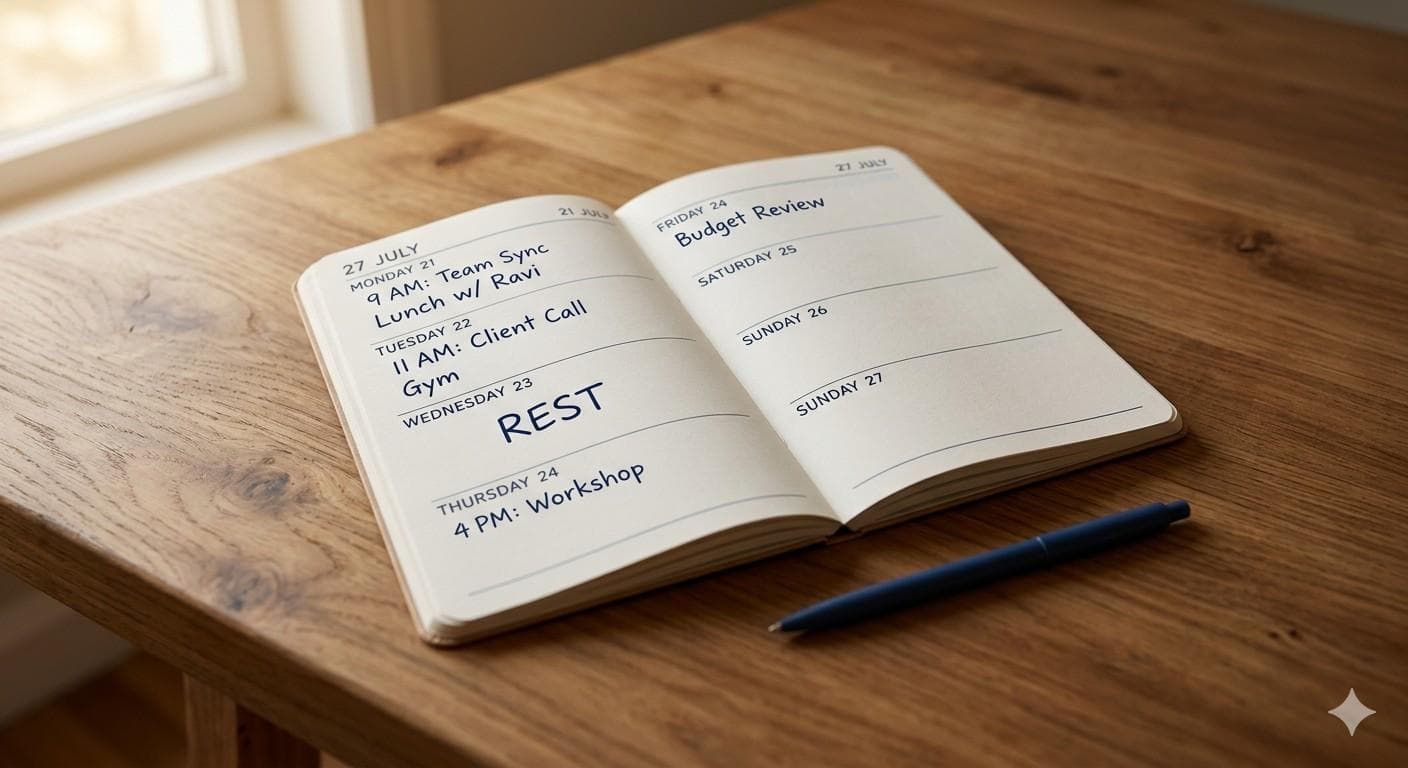
The uncomfortable truth about rest is that it won't happen automatically. In a world structured around productivity, stimulation, and the constant availability of content, unscheduled rest time will always be filled with something. The notification will arrive. The recommendation will appear. The thought will occur — "I could just quickly check..." And the rest period disappears. This is why rest requires the same kind of intentionality as any other valued activity. It must be scheduled. It must be protected. And it must be defined — because "rest time" without a clear idea of what that means defaults back to passive consumption. Scheduled rest looks like: A 20-minute period after lunch where you sit without a phone — perhaps walk slowly, sit outside, or simply close your eyes. Not meditation necessarily. Just stillness. A reading hour in the evening — fiction, specifically. Fiction requires imagination and emotional engagement, but it doesn't produce the arousal and comparison that social media does. It occupies the mind gently. A walk without earphones. The unstructured wandering of attention — noticing things, thinking freely, following thoughts without direction — is one of the most restorative activities available and requires no equipment or preparation. A bath or slow shower taken for its own sake, not as a task to be completed. The thermal experience of warm water, the absence of stimulation, and the enclosed environment combine to produce a reliable parasympathetic activation — the body's rest and digest response. One full day per week with no planned obligations. Not a day of catching up. Not a day of productive errands. A day where you follow whatever presents itself — the book you feel like reading, the walk you feel like taking, the meal you feel like cooking. This is not indulgence. It is recovery.
The Role of Boredom
Boredom has been almost entirely eliminated from modern life. The phone ensures that any moment of unoccupied attention can be immediately filled. Waiting for something, sitting in transit, pausing between tasks — all of these naturally occurring rest moments are now reflexively filled with content. This is a significant loss. Boredom — genuine, unresolved boredom where the mind is left without direction — is one of the primary triggers for creative thought, self-reflection, and the spontaneous problem-solving that produces genuine insight. The ideas that arrive in the shower, on a long drive, or during a slow walk don't arrive because those activities are special. They arrive because those are the few remaining contexts where the mind is left without direction. Protecting small pockets of boredom — resisting the phone in the lift, sitting with the discomfort of an unoccupied moment — is a form of mental hygiene with disproportionate creative and psychological returns.
Rest in the Context of a Full Life
This isn't an argument for doing less. Most people with meaningful work, families, and ambitions cannot and should not dramatically reduce their activity. The argument is for doing the same things better — by building genuine rest into the structure of the day and week. Twenty minutes of real stillness. A weekly day without obligation. Walks without earphones. Fiction before bed instead of a screen. These are not grand life changes. They're small architectural adjustments to how time is spent — ones that produce compounding returns in clarity, creativity, patience, and sustained energy. The person who rests well is not less productive than the person who never stops. They are more productive, more creative, and more present. And they last longer.
A Simple Rest Framework

Daily: One 15–20 minute period of genuine non-stimulation. A slow walk, sitting outside, or lying down without a phone. After lunch is natural for many people. Evening: Replace 30 minutes of screen time with something that engages gently without stimulating — reading fiction, listening to music without doing anything else, slow cooking. Weekly: One day or half-day with no planned obligations. Follow what presents itself. Monthly: One longer period — a day completely away from work context. Not a holiday necessarily. Just a day where the work identity is set aside entirely.
“Disclaimer: This content was created with AI assistance and reviewed before publication. It is for informational purposes only and not professional medical, nutritional, legal, or financial advice”